
|
MALAGA IN THE HISTORY | | Conchi Navarro. 20.12.15 | |  The city was founded by the Phoenicians, who built a settlement near the hill on which the Alcazaba stands today. During Roman times, Malaga obtained the benefits of being declared a confederated city of Rome. Under the rule of the Moors, the city enjoyed an era of great progress, however, in 1487 it was re-conquered by the Catholic Monarchs, following which it fell into relentless decline. By the end of the 18th century, beginning of the 19th, a high-class bourgeoisie had been formed, comprised mainly of two families: the Larios and the Heredia, thanks to whom Malaga became the second most important industrial centre in the country. Converted into a world capital of tourism, thanks to the development of the Costa del Sol, today Malaga continues to grow. | 1. STATUE OF HANS CHRISTIAN ANDERSEN. Plaza de la Marina.
He stayed in our city at the beginning of October 1862 and wrote his book I Spanien (In Spain). Captivated by the beauty of Malaga, its sea, its luminosity and its people, the author of The Mermaid, wrote "in no other Spanish city have I been as happy and as comfortable as in Malaga."
2. AC HOTEL MÁLAGA PALACIO
HOTEL MOLINA LARIO.
Calle Molina Lario
Don’t miss a visit to their bar and restaurant on the upper floor of either of these hotels to enjoy impressive views of the city. You can have a coffee or just take some photos.
3. PLAZA DEL OBISPO
This square is located in front of the Episcopal Palace, next to the Cathedral. It is a small square but with great monumental interest, enclosed as it is by two huge religious buildings and with a beautiful fountain that dates back to 1785 and was supplied with water from the San Telmo Aqueduct.
4. EPISCOPAL PALACE. Also in the Plaza del Obispo.
PERIOD 16th - 18th century
The Episcopal Palace is the name given to a group of buildings that make up a large block between calle Santa María, calle Molina Lario, calle Salinas, calle Fresca and the Plaza del Obispo. It is a conglomerate of different buildings of different shapes and styles that have undergone numerous transformations over the centuries, depending on their use. Part of this group of buildings currently houses the Diocesan Museum and is used as an exhibition hall.
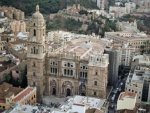 5. CATHEDRAL. Opposite the Plaza del Obispo. 5. CATHEDRAL. Opposite the Plaza del Obispo.
One of the best Andalusian Renaissance temples.
The Catholic Monarchs ordered the construction of the building. It is popularly known as La Manquita “one-armed”.
The cathedral of the Encarnación is one of the town's most important monuments. The south tower and the main façade are unfinished. It is situated in the historic centre of the town. The building sits where a mosque-Moorish quarter once existed. Work began in the first half of the 16th century, in the Gothic style, ordered by the Catholic Monarchs, and continued in the 17th and 18th centuries. It has its own gardens and a magnificent courtyard. The interior of the cathedral has Renaissance and Baroque influences. Most noteworthy are the choir stalls (17th century) in the central nave and, especially, the sculptural works of Pedro de Mena. The chapels are also very interesting, such as that of the Encarnación, which gives the cathedral its name.
6. REVELLO DE TORO MUSEUM. Walk 1’, turn on the right. Calle Císter. Walk for 4 minutes.
The museum permanently exhibits the collection that the famous portrait artist and figurative painter Félix Revello de Toro has left to his native city, Málaga. Besides, the Revello de Toro Museum has allowed for the restoration and the promotion of the importance of the workshop and home of Pedro de Mena, one of the few domestic buildings in Málaga of the 17th century. Pedro de Mena is a relevant maker of religious images in the 17th century.
7. ALCAZABA. Calle Alcazabilla.
PERIOD 11th - 15th century
This impressive building, built mostly in the 11th century, was the palace-fortress of the city's governing Muslims. It was built on the summit of a hill, adapted to the relief. It is formed by two walled areas, the lower, which is a huge space that follows the topography of the hill and surrounds the upper part completely. This latter, within which the palace stands, is also adapted to the lines of the hill and has strong defensive elements at each end. It has a lift that runs from calle Guillén Sotelo, behind the Town Hall.
8. ROMAN THEATRE. Calle Alcazabilla
PERIOD 1st Century B.C.
The Roman theatre is situated at the foot of the Alcazaba. It was discovered in 1951 during the works to build a garden at the entrance of the Citizens' Arts Centre. The theatre was built in times of Augustus and was used until the 3rd century; after that it was used as a quarry by the Moors to restore the Alcazaba, where Roman column shafts and capitals can be seen. Today, the areas left uncovered are the entrance gallery to the proscenium stage, which had a barrel vaulted ceiling, part of the orchestra area of around 15 m with three tiers, a radius of 31 m and a height of 16 m, as well as the vomitorium or accesses to the seating tiers.
9. BODEGAS EL PIMPI. Calle Alcazabilla.
This bodega bar has long been a city icon and meeting place. Opened in 1971, El Pimpi is situated inside an old 18th century Málaga mansion house and is one of the longest-standing bodega bars in Málaga. Here you can taste the typical sweet Malaga wine.
Its name harks back to the ‘Pimpi’, a local Málaga character who used to help the crews and passengers from the ships that arrived at the city docks. Generations of personalities from the worlds of flamenco, politics and arts have visited it.
10. ALCAZABA PREMIUM HOSTEL. In front of El Pimpi, near the cinema.
With the city at your feet, its rooftop terrace has breathtaking views of the Alcazaba and Gibralfaro castles. It has a relaxed and cosy atmosphere perfect to eat or have a drink.
11. PLAZA DE LA MERCED
This square is to be found at the end of calle Alcazabilla and it contains the obelisk erected as a tribute to General Torrijos, as well as the house where Picasso was born, currently the headquarters of the Picasso Foundation. This square witnessed Pablo Ruiz Picasso's first games as a child. It was here, in this busy and romantic corner of Malaga, that his parents met.
At the end of the 15th century the square housed a public market and by the end of the 19th century it had become a place where the bourgeoisie dedicated themselves to pleasure and leisure. A mosaic of different personalities, which in time, the artist would reflect in his works, heard thus the bells of the La Merced Church, next to Picasso's house. The shouts of vendors selling turkeys, milk from straight from the goat, sweets, jasmine posies, jams or guitars, merged with the chatter of servants and soldiers around the monolith that stands in the centre of this tree-lined square dedicated to General Torrijos, its slogans of freedom and justice constituting a point of reference to that child called Pablo Ruiz Picasso. Furthermore, even today the square is filled with the flight of pigeons and doves. They are the doves that Picasso, from when he was a child and until his death, painted - by the hand of his father - as the eternal and legendary emblem of his extensive work.
Look for the statue of Picasso, close to his house.
12. IGLESIA DE SANTIAGO. Calle Granada.
PERIOD 15th - 18th century
Situated in calle Granada, this church was built on the site of a former mosque. It is Malaga's oldest church, having been founded on 25th July 1490. Of the original façade only the Mudejar style central entrance remains (boarded up). The beautiful tower is also Mudejar, whilst the interior of the temple is Gothic-Mudejar and has three naves. In this church Picasso was christened in 1881.
13. PICASSO MUSEUM. Calle San Agustín.
Museo Picasso Málaga was created in response to Pablo Picasso’s own desire for his work to be present in the city where he was born on 25 October 1881. The museum was created thanks to Christine and Bernard Ruiz-Picasso, the artist’s daughter-in-law and grandson, whose donations constitute the core of the collection. It was also made possible thanks to the efforts of the Junta de Andalucía, which coordinated the major project of setting up a museum devoted to the artist whose styles and techniques changed the course of modern art.
Go back to Calle Granada. Walk down, the street makes an L to the right and then to the left, in 8 minutes walking you arrive to…
14. PLAZA DE LA CONSTITUCIÓN
This square originally called 'Main Square' or, during the Nazari period, 'Square of the Four Streets', became Constitution Square in 1812. Since before Christianity, it had been the heart of the city's historical quarter and since the 15th century to the present day, it has been the city's public and political space, par excellence. In fact, it could be said that all the city's important political events of modern, contemporary Spain have taken place in this open space. Until 1869 the Chapter House or Town Hall was located in this square, as were other official buildings such as the house of Justice, the prison, and the Jesuits School.
15. SOCIEDAD ECONÓMICA DE AMIGOS DEL PAÍS. Also in Plaza de la Constitución, on the right.
The Economic Society of the Friends of the Country is a 17th century baroque classicist building. In 1856 it became the headquarters of the Economic Society of the Friends of the Country, which aims to promote agriculture, industry, commerce and education.
Nowadays the building is devoted to the dissemination of knowledge in various fields, a library, conferences and exhibitions.
Its façade is classified as a balcony building because it has several balconies, two of which run round the second and third floors for watching the festivities held below. It was renovated in 2004 when the ancient splendour of elements such as the marble at the entrance or the medallion in the attic with the slogan "Aid the diligent, Deny the lazy" was reinstated.
16. CARMEN THYSSEN MUSEUM. Calle Compañía.
The Carmen Thyssen Museum is one of the most important museums of the city of Málaga, which is now called "the city of museums". The main focus of the museum is 19th-century Spanish painting, predominantly Andalusian, based on the collection of Carmen Cervera a Spanish actress that became the third wife of Baron Hans Heinrich Thyssen-Bornemisza.
Since 1992 the Thyssen family's art collection has been on display at the Thyssen-Bornemisza Museum in Madrid. However, Carmen Thyssen has been an art collector in her own right since the 1980s, and her personal collection is shown separately. In 1999, she agreed to display many items from her collection in the Thyssen-Bornemisza Museum for a period of twelve years. Meanwhile, a home for her collection was sought in Málaga. This museum, a conversion of a sixteenth-century building, opened to the public on 24 March 2011. Our city is grateful for that and all the surrounding area has been renovated.
Go back to Plaza de la Constitución and walk along the beautiful main street: Calle Larios. At the end you will be again at the meeting point: Plaza de la Marina. |
|
| | <-Volver |
|
|


 Enviar esta noticia
 Compartir en facebook